Premium content is valuable. Protected premium content is profitable.
For years, the OTT industry focused on a single objective: growth. The formula was simple. Acquire content, launch applications, attract viewers, and scale subscriptions as quickly as possible.
That strategy worked when streaming was still maturing. In 2026, however, streaming businesses are operating in a completely different environment.
The market has become more competitive. Content licensing has become more expensive. Customer acquisition costs continue to rise. Meanwhile, piracy has evolved into a sophisticated industry of its own.
Today, premium content can be redistributed globally within minutes of being published. Illegal IPTV networks have become more organized. Credential-sharing marketplaces are growing. Browser-based recording tools have become increasingly accessible, and AI is accelerating how quickly bad actors can exploit vulnerabilities.
The biggest misconception businesses still have is believing OTT security is an IT responsibility.
It isn't. It is now a business responsibility.
Every unauthorized stream affects monetization. Every leaked event impacts licensing relationships. Every weak security layer creates friction between content owners, distributors, and audiences.
This shift is forcing OTT businesses to ask a different question.
Instead of asking, “How do we secure our content?”
They are asking:
“How do we build a streaming business that can scale securely for the next decade?”
The answer is no longer a single technology.
It is an ecosystem.
In this article, we will explore how modern streaming businesses are building that ecosystem and why security has become one of the most important competitive advantages in OTT.
Executive Summary: 5 Things Every OTT Decision-Maker Should Know
Before diving deeper, here are five key takeaways:
✓ DRM is essential, but it is no longer enough on its own.
✓ Credential sharing has become one of the biggest hidden revenue leaks in OTT.
✓ Security investments now directly influence subscriber retention and licensing opportunities.
✓ Layered security frameworks outperform standalone tools.
✓ Unified OTT ecosystems are replacing fragmented vendor stacks.
The Hidden Revenue Leaks Most Streaming Businesses Never Measure
One of the biggest mistakes OTT businesses make is underestimating invisible losses.
These losses rarely appear on dashboards immediately, yet they accumulate over time.
Revenue Leakage Sources
Revenue Leak | Business Impact |
Credential sharing | Reduced subscriptions |
Illegal IPTV redistribution | Lower monetization |
Poor playback security | Higher churn |
Vendor sprawl | Operational inefficiencies |
Content leaks | Damaged partnerships |
Many businesses focus heavily on acquiring subscribers.
Fewer businesses focus on protecting the value of those subscribers.
As competition intensifies, retention is becoming more valuable than acquisition.
Protecting subscribers is becoming just as important as attracting them.
Interpretation:
More than half of modern piracy stems from credential sharing and illegal IPTV redistribution. Businesses that prioritize access management and anti-restreaming capabilities are significantly better positioned to protect revenue.
Why DRM Alone Is No Longer Enough
Digital Rights Management remains one of the most important technologies in OTT.
However, businesses often overestimate what DRM can accomplish.
DRM encrypts content and controls playback authorization.
It does not solve every security challenge.
DRM cannot independently stop:
Credential sharing
Social engineering attacks
Infrastructure vulnerabilities
Account takeovers
Illegal IPTV redistribution
Browser-based recording tools
Think of DRM as a high-quality lock.
A lock is important.
But securing an entire building requires cameras, alarms, access controls, monitoring systems, and continuous surveillance.
The same principle applies to streaming.
Modern OTT security requires multiple layers working together simultaneously.
Why Multi-DRM Has Become Non-Negotiable
Today's viewers are device agnostic.
They expect seamless experiences across smartphones, laptops, tablets, gaming consoles, and smart TVs.
No single DRM solution supports every environment.
This is why Multi-DRM has become essential.
Core Multi-DRM Technologies
Technology | Ecosystem |
Widevine | Android, Chrome |
FairPlay | Apple |
PlayReady | Microsoft |
Businesses that ignore Multi-DRM risk creating inconsistent experiences that frustrate viewers.
Security and customer experience are now interconnected.
Strong protection should never create friction.
This is one of the reasons platforms like Vodlix are simplifying deployment by centralizing Multi-DRM management under one ecosystem.
The 7-Layer OTT Security Framework Modern Businesses Are Adopting
The strongest OTT businesses no longer depend on individual tools.
They build security ecosystems.
Layer 1: Video Encryption
Encryption transforms content into unreadable data until authorized playback occurs.
Layer 2: Forensic Watermarking
Invisible identifiers make leaks traceable.
Layer 3: Tokenized URLs
Temporary access links reduce unauthorized sharing.
Layer 4: Geo-Blocking
Content distribution remains aligned with licensing agreements.
Layer 5: Concurrent Stream Management
Subscriber integrity improves significantly.
Layer 6: Secure CDN Delivery
Content remains protected during delivery.
Layer 7: AI Anti-Piracy Monitoring
Threats are identified faster.
Businesses adopting layered security strategies are consistently outperforming those that depend solely on DRM.
Security Priorities Change Across Different OTT Business Models
Every streaming business faces different risks.
OTT Security Priorities by Business Model
OTT Model | Biggest Challenge | Recommended Priority |
SVOD | Credential sharing | Concurrent streams |
AVOD | Ad fraud | AI monitoring |
FAST | Signal theft | Secure CDN |
Sports | Live event piracy | Watermarking |
Education | Content downloads | Multi-DRM |
Corporate Streaming | Unauthorized access | Role controls |
There is no universal security strategy.
Businesses should align security investments with their business models.
Protect Revenue Before You Scale
Launching first and securing later is one of the most expensive mistakes OTT businesses make.
Enterprise-grade security becomes significantly more difficult to retrofit once platforms have already scaled.
Vodlix helps businesses build secure foundations from day one.
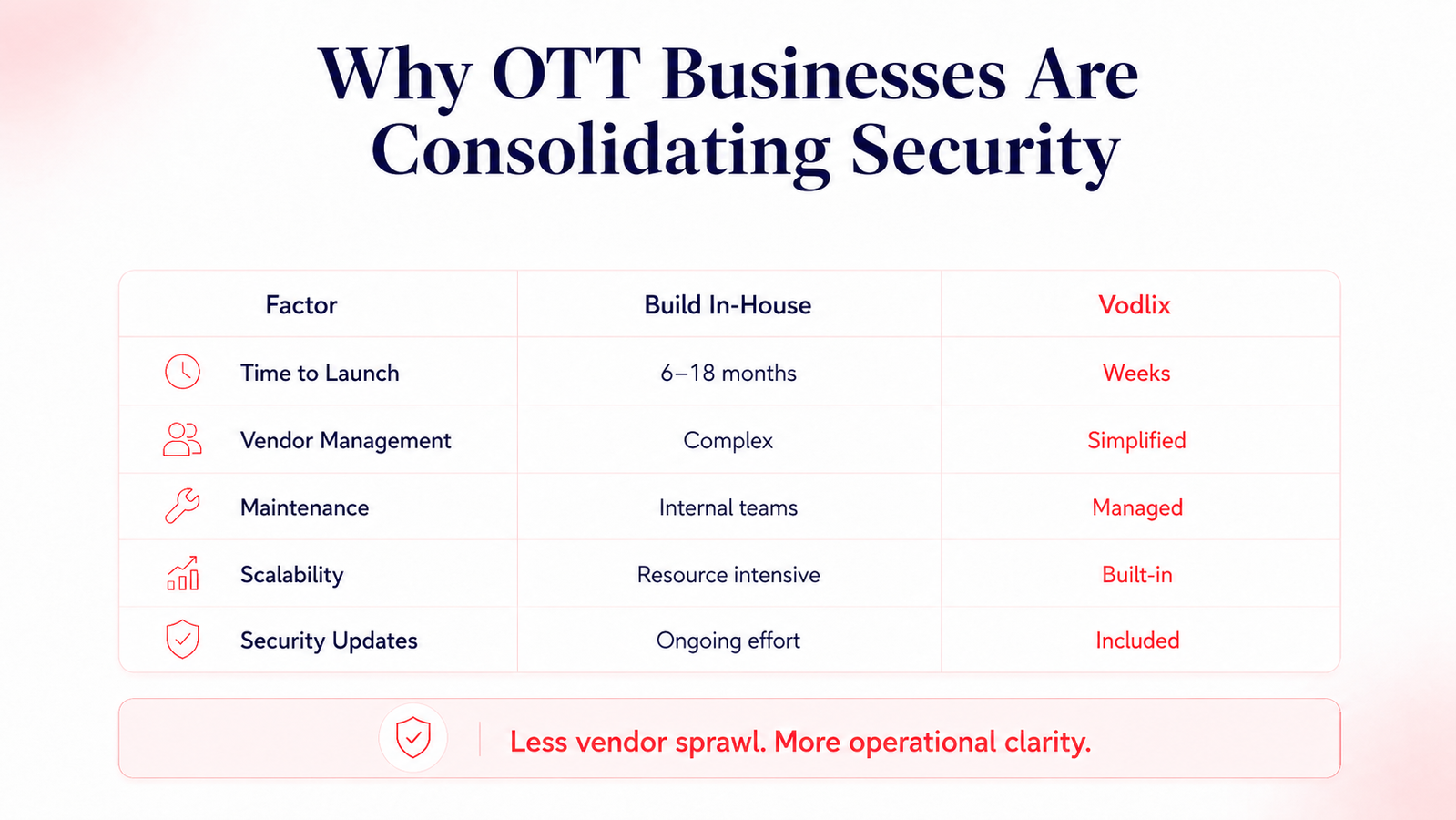
As businesses grow, vendor sprawl often becomes a hidden operational burden.
Consolidation is becoming a strategic advantage.
Why Businesses Are Moving Toward Unified OTT Ecosystems
The streaming industry is experiencing a major operational shift.
Businesses are moving away from fragmented infrastructures.
Instead of managing separate vendors for:
Hosting
DRM
Analytics
Monetization
CDN
Applications
They are consolidating operations into unified ecosystems.
Benefits include:
This trend will continue accelerating throughout the decade.
Why Businesses Choose Vodlix
Vodlix is built around a simple principle.
Streaming businesses should spend time growing audiences, not stitching together infrastructure.
By centralizing critical technologies into one platform, businesses gain access to:
✓ Multi-DRM
✓ Secure hosting
✓ White-label OTT applications
✓ Global CDN delivery
✓ Geo-blocking
✓ Analytics
✓ Monetization
This allows organizations to launch faster while maintaining enterprise-grade security.
The Future of OTT Security Is Invisible
Consumers do not subscribe because platforms have strong security.
They subscribe because everything works seamlessly.
The best security systems are often invisible.
Several trends will define the next generation of streaming security.
AI Security Agents
Automated threat detection.
Dynamic Watermarking
Adaptive leak tracking.
Passwordless Authentication
Passkeys and biometrics.
Zero Trust Architectures
Continuous verification.
Behavioral Intelligence
Threat detection before incidents occur.
The future of OTT will belong to businesses that combine frictionless experiences with invisible protection.
Conclusion
The OTT industry has entered a new era.
Security is no longer an optional investment.
It is a business strategy.
Businesses that prioritize security build stronger licensing relationships, improve subscriber retention, and create sustainable foundations for growth.
The strongest streaming businesses in 2026 will not have the most tools.
They will have the smartest ecosystems.
By combining security, monetization, infrastructure, and scalability into one platform, Vodlix helps businesses focus on growth instead of complexity.

.png)