Learn how a Multi-CDN strategy improves OTT performance, reliability, scalability, and global video delivery. Discover best practices for enterprise streaming platforms.
Imagine millions of viewers tuning in to watch the final moments of a championship match.
Traffic doubles within minutes. Thousands of new viewers join every second. Social media drives an unexpected surge, and one content delivery network begins experiencing congestion.
For the viewer, the result is immediate. Videos buffer. Playback quality drops. Some streams fail to start altogether.
For the streaming platform, the consequences extend far beyond a technical issue. Every interruption can lead to abandoned viewing sessions, subscription cancellations, lost advertising revenue, and damage to brand reputation.
This is why enterprise OTT platforms no longer depend on a single Content Delivery Network.
Instead, they use Multi-CDN strategies that continuously evaluate network performance and intelligently route every viewer through the fastest and most reliable delivery path.
As streaming audiences become increasingly global, resilient content delivery has evolved from an infrastructure decision into a competitive advantage.
This guide explains how Multi-CDN works, why it has become the enterprise standard, and what every OTT business should know before scaling globally.
What Is a Multi-CDN Strategy?
A Content Delivery Network, commonly known as a CDN, is a distributed network of servers that stores and delivers content from locations closer to end users.
Instead of serving every video from a single origin server, CDNs cache content across hundreds of edge locations worldwide. When a viewer starts watching a video, the CDN delivers the content from the nearest or most efficient location, reducing latency and improving playback quality.
A Multi-CDN strategy takes this concept one step further.
Instead of relying on a single CDN provider, enterprise OTT platforms use two or more CDN networks simultaneously. Intelligent traffic management systems continuously evaluate network performance and direct viewers to the CDN that can deliver the best experience at that moment.
This dynamic approach helps streaming services maintain high availability even if one provider experiences congestion or an outage.
Think of it as using multiple highways instead of relying on a single road. If traffic builds up on one route, vehicles can automatically be redirected to a faster alternative without disrupting the journey.
For viewers, this transition happens behind the scenes. They simply experience faster video startup, fewer buffering interruptions, and more consistent playback.
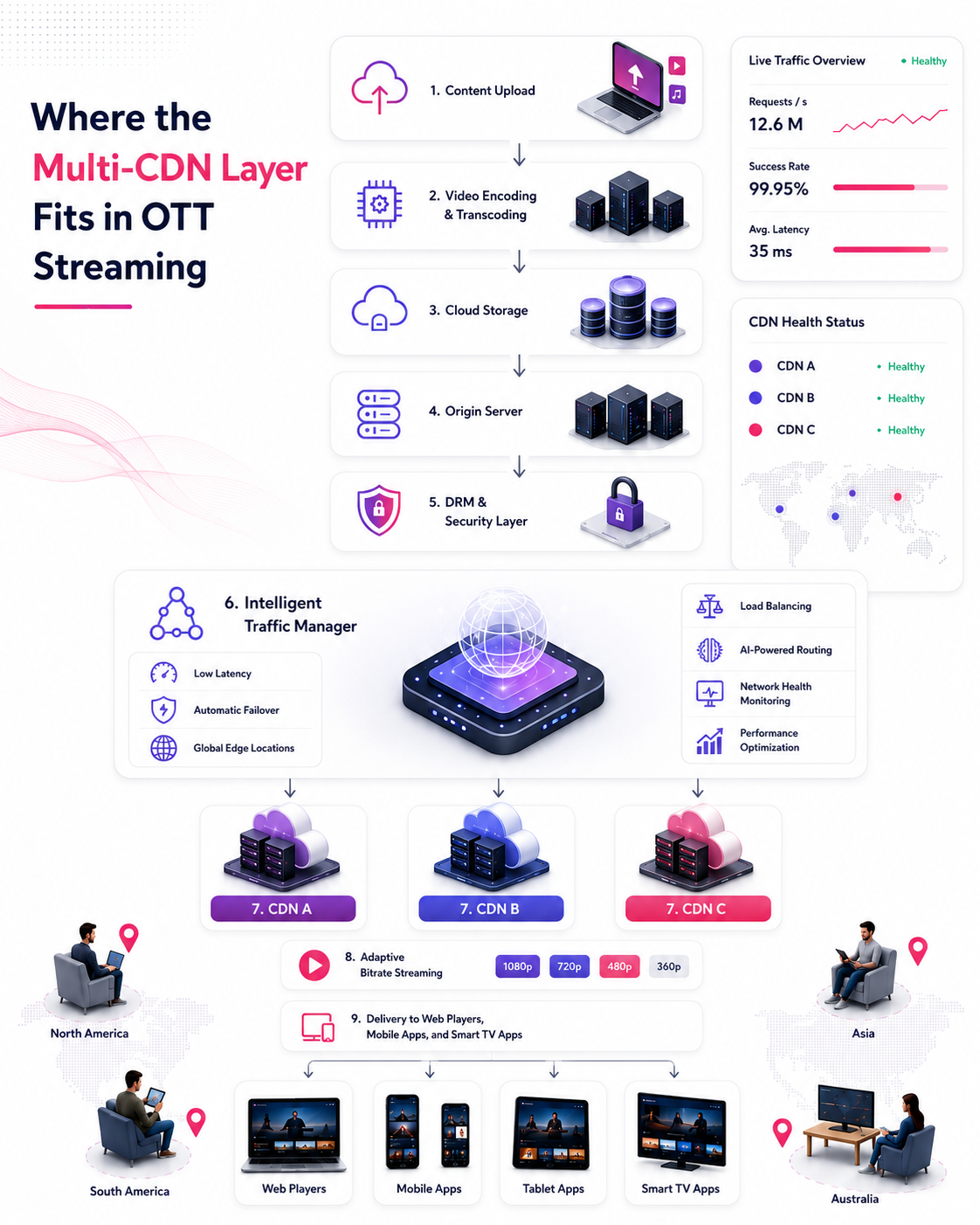
Where Multi-CDN Fits in an Enterprise OTT Architecture
Many people think a CDN delivers video directly from storage to viewers.
In reality, enterprise streaming platforms include multiple interconnected services working together behind the scenes.
Although every layer contributes to the streaming experience, the traffic management layer plays one of the most important roles. It determines which CDN should serve each viewer based on real-time conditions, helping reduce latency, improve availability, and maintain consistent playback quality worldwide.
Why a Single CDN Is No Longer Enough
When OTT platforms were primarily serving regional audiences, a single CDN often met performance expectations.
Today's streaming landscape is very different.
Content providers now serve viewers across continents, multiple internet service providers, thousands of device types, and millions of simultaneous connections.
Several factors make relying on a single CDN increasingly risky.
Geographic Performance Differences
No CDN performs equally well in every country.
One provider may offer exceptional performance in North America while another delivers lower latency in Southeast Asia or the Middle East.
Using multiple CDN providers allows traffic to be routed through the network that performs best in each region.
Unexpected Network Outages
Even the largest CDN providers occasionally experience service disruptions.
If an OTT platform depends entirely on one provider, viewers may experience playback failures until the issue is resolved.
A Multi-CDN strategy minimizes this risk by automatically shifting traffic to healthy CDN providers.
Traffic Spikes During Live Events
Major sports events, concerts, product launches, and breaking news can generate sudden traffic spikes.
A single CDN may become overloaded during these periods.
Distributing traffic across multiple providers helps maintain consistent performance under heavy demand.
Better Viewer Experience
Every second matters in streaming.
Research consistently shows that longer startup times and frequent buffering increase viewer abandonment rates.
By routing users through the fastest available network, Multi-CDN strategies help reduce latency, improve Quality of Experience (QoE), and increase viewer satisfaction.
What Actually Happens When a Viewer Presses Play?
Imagine two viewers pressing play on the same movie at exactly the same moment.
One viewer is in London.
The other is in Singapore.
Although both request the same content, they may receive it through completely different delivery paths.
The London viewer could be routed through a CDN with exceptional performance across Europe, while the Singapore viewer is automatically connected to another provider that offers lower latency throughout Asia.
Neither viewer notices this decision.
They simply experience fast startup times, smooth playback, and high-quality video.
Behind the scenes, however, the traffic management layer has already evaluated dozens of performance indicators before selecting the most efficient delivery path.
This is the practical advantage of a Multi-CDN strategy. Instead of assuming one network performs best everywhere, the platform makes an intelligent decision for every individual playback request.
Expert Insight
Enterprise OTT providers no longer evaluate CDNs solely on coverage. They evaluate them on measurable business outcomes such as startup time, rebuffering ratio, playback success rate, and subscriber retention. Multi-CDN strategies help optimize each of these metrics while reducing operational risk.
Single CDN vs Multi-CDN
Choosing between a single CDN and a Multi-CDN strategy depends on your platform's scale, audience distribution, and reliability requirements.
For enterprise OTT businesses serving global audiences, the differences are significant.
Capability
Single CDN
Multi-CDN
Global coverage
Depends on one provider
Optimized across multiple providers
Availability
Limited to one network
High redundancy with automatic failover
Performance
Varies by region
Optimized based on real-time conditions
Scalability
Can become constrained during traffic spikes
Handles large-scale demand more efficiently
Outage protection
Vulnerable to provider outages
Traffic automatically shifts to healthy networks
Viewer experience
Inconsistent across some regions
More consistent worldwide
Cost optimization
Fixed provider pricing
Traffic can be routed based on performance or cost
Operational resilience
Moderate
High
For organizations investing in long-term OTT growth, Multi-CDN provides greater flexibility and resilience than relying on a single provider.
Why Multi-CDN Is Becoming the Enterprise Standard
The shift toward Multi-CDN is being driven by both technical and business priorities.
Streaming platforms are expected to deliver television-quality experiences across every device, regardless of network conditions.
At the same time, businesses are under pressure to reduce churn, improve engagement, and expand into new markets without compromising reliability.
A well-designed Multi-CDN strategy helps achieve these objectives by combining intelligent traffic management with distributed infrastructure.
Instead of asking, "Which CDN is the best?" enterprise teams increasingly ask, "Which CDN is best for this viewer, at this moment?"
That difference in thinking is what separates modern streaming architectures from legacy delivery models.
How a Multi-CDN Strategy Works
A Multi-CDN strategy is far more sophisticated than simply connecting multiple CDN providers to your streaming platform. The real value comes from the intelligence layer that continuously determines which CDN can deliver the best experience for every viewer.
Each time a user clicks Play, several decisions happen within milliseconds. The platform evaluates factors such as the viewer's location, current network conditions, CDN health, latency, bandwidth availability, and server load before selecting the optimal delivery path.
This process is completely transparent to the viewer. They simply experience faster startup times, smoother playback, and fewer interruptions.
For enterprise OTT platforms serving audiences across dozens of countries, this intelligent routing becomes one of the most important components of the streaming infrastructure.
The Key Components of a Multi-CDN Architecture
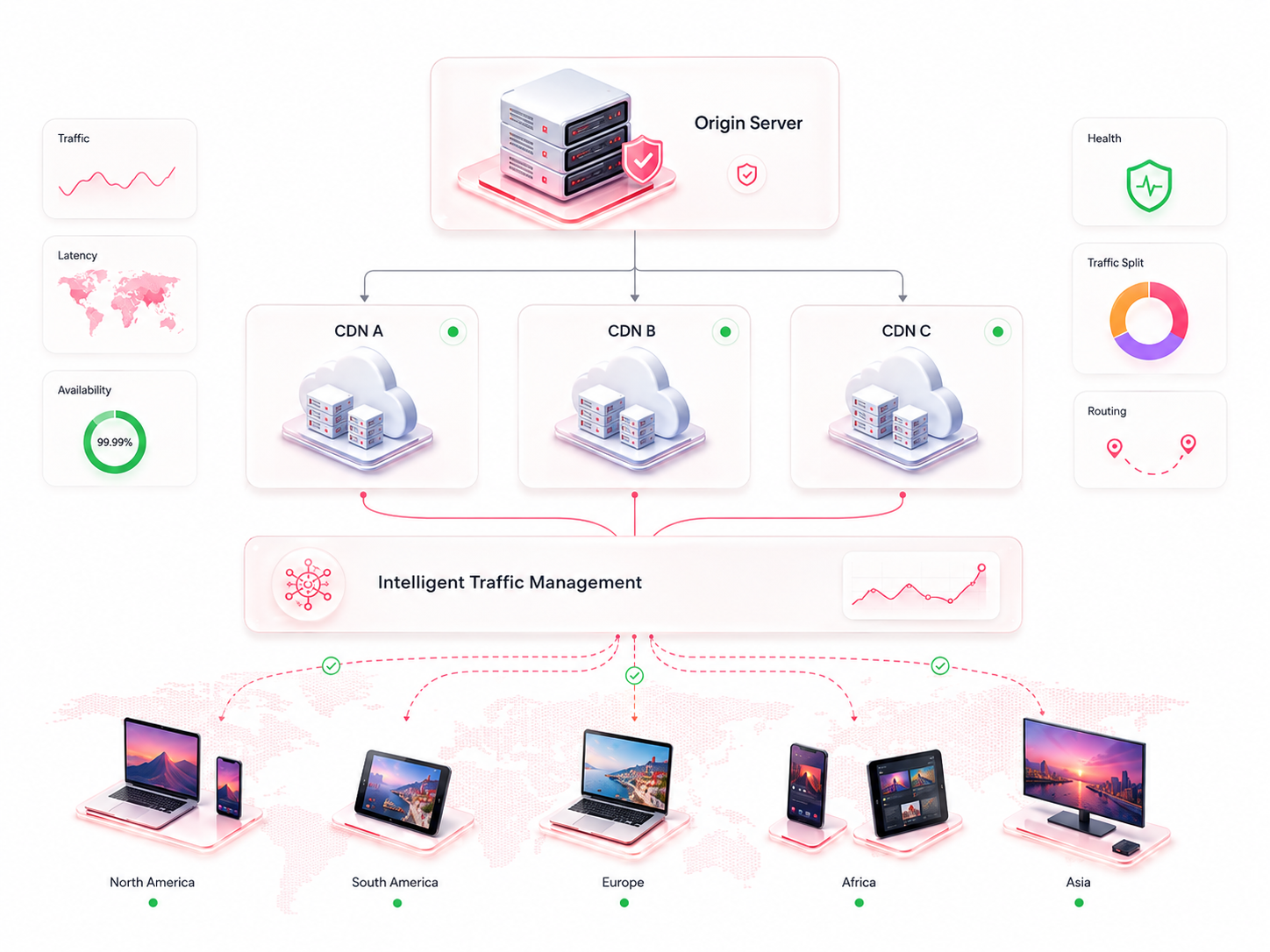
A modern Multi-CDN environment consists of several interconnected layers that work together to optimize video delivery.
Origin Server
The origin server stores the master copy of your video assets. Rather than delivering every request directly to viewers, it distributes content to multiple CDN providers that cache the files closer to end users.
Multiple CDN Providers
Instead of relying on a single network, enterprise platforms integrate several CDN providers, each with strengths in different geographic regions or network environments.
This diversity improves resilience and enables better regional performance.
Enterprise streaming platforms rarely assume that one CDN performs best everywhere.
A provider that delivers outstanding performance across North America may not offer the same latency in Southeast Asia, South America, or parts of Africa.
For this reason, engineering teams often evaluate providers such as Akamai, Cloudflare, Fastly, Amazon CloudFront, and regional CDN partners based on geographic performance, commercial agreements, and workload requirements.
The objective is not to identify the single best CDN. It is to combine multiple delivery networks into one intelligent global infrastructure.
Traffic Management Layer
The traffic management layer acts as the decision engine.
It continuously evaluates real-time performance data and determines which CDN should serve each request.
Rather than making static routing decisions, modern traffic managers adapt dynamically as network conditions change.
Monitoring and Analytics
Continuous monitoring is essential for Multi-CDN success.
Streaming platforms track metrics such as:
Latency
Availability
Packet loss
Throughput
Cache hit ratio
Video startup time
Buffering frequency
Playback success rate
These insights allow routing decisions to be adjusted automatically without manual intervention.
Inside a Real-Time Traffic Decision
Every playback request triggers dozens of infrastructure decisions within milliseconds.
Modern traffic managers evaluate multiple performance signals before selecting the optimal CDN.
Decision Factor
Why It Matters
Viewer location
Routes users to the nearest high-performing edge server
ISP performance
Some CDN providers perform better on specific networks
Current latency
Reduces startup delay and buffering
CDN health
Avoids degraded or unavailable networks
Regional traffic levels
Prevents congestion during peak demand
Cache availability
Delivers content faster without returning to the origin server
Cost policies
Balances delivery performance with infrastructure costs
These decisions happen automatically and continuously, allowing enterprise OTT platforms to maintain consistent streaming quality even as network conditions change.
Common Multi-CDN Routing Strategies
Not every platform routes traffic the same way.
Enterprise OTT providers often combine several routing methods to maximize performance and availability.
Geographic Routing
Traffic is directed to the CDN that performs best within a specific region.
For example:
North America may use one provider.
Europe may use another.
Asia-Pacific may be served by a third network.
This approach helps reduce latency while improving regional reliability.
Performance-Based Routing
Instead of relying only on geography, the platform measures real-time network performance.
If one CDN begins experiencing increased latency or packet loss, traffic is automatically redirected to another provider delivering better results.
This ensures viewers consistently receive the highest-quality streaming experience.
Health-Based Routing
Every CDN is continuously monitored.
If a provider experiences an outage or significant degradation, requests are immediately redirected to healthy CDN partners.
For viewers, this transition typically happens without noticeable interruption.
Cost-Aware Routing
Large OTT businesses often balance performance with operational efficiency.
When multiple CDN providers deliver similar performance, traffic may be routed to the provider offering lower delivery costs in that region.
This helps optimize infrastructure spending while maintaining quality.
AI-Powered Traffic Steering
The newest generation of enterprise OTT platforms increasingly relies on artificial intelligence and machine learning.
Rather than reacting to network issues after they occur, AI models analyze historical and real-time performance data to predict congestion before viewers are affected.
Benefits include:
Faster routing decisions
Improved playback quality
Reduced buffering
Better load balancing
Continuous optimization
As streaming audiences continue growing, predictive traffic management is becoming a major competitive advantage.
Active-Active vs Active-Passive Architectures
Enterprise platforms generally choose one of two deployment models.
Architecture
Active-Active
Active-Passive
Traffic Distribution
Multiple CDNs serve traffic simultaneously
One CDN serves traffic until failover is required
Availability
Very high
High
Resource Utilization
Excellent
Moderate
Failover Speed
Nearly instant
Fast
Operational Complexity
Higher
Lower
Best For
Global enterprise OTT platforms
Smaller streaming businesses
Active-active architectures provide the highest level of redundancy because traffic is already distributed across multiple providers.
Active-passive deployments are simpler to manage but rely on backup infrastructure only when issues occur.
Why Intelligent Routing Matters
Imagine a viewer in Singapore attempting to watch a live sporting event.
At that moment:
CDN A may be experiencing congestion.
CDN B may have lower latency.
CDN C may have available capacity but higher startup times.
A traditional streaming platform using a single CDN has no choice but to deliver the stream through that provider.
A Multi-CDN platform automatically selects the network capable of delivering the best experience.
This decision happens in milliseconds and significantly improves playback quality.
Multiply this process across millions of viewers and the business impact becomes substantial.
Inside a Real-Time Traffic Decision
Every playback request triggers dozens of infrastructure decisions within milliseconds.
Typical routing inputs include:
Metric
Why It Matters
Viewer location
Select the nearest high-performing edge server
ISP performance
Some providers perform better on certain networks
Current latency
Reduce startup delay
CDN health
Avoid degraded networks
Regional traffic
Prevent congestion
Cache availability
Improve delivery speed
Cost policies
Balance performance with operational efficiency
No engineer manually makes these decisions.
Modern traffic managers continuously evaluate these metrics and automatically steer traffic toward the best-performing network.
Business Benefits of a Multi-CDN Strategy
For enterprise streaming platforms, Multi-CDN is not simply an infrastructure enhancement. It directly influences customer satisfaction, operational efficiency, and long-term revenue growth.
Better Video Quality
Consistent delivery reduces buffering and playback interruptions.
Viewers remain engaged for longer sessions, increasing watch time and improving overall satisfaction.
Higher Platform Availability
Service interruptions become far less likely because traffic automatically shifts away from underperforming CDN providers.
High availability is particularly important during live broadcasts and premium events.
Lower Subscriber Churn
Users quickly lose confidence in platforms with unreliable streaming.
Reliable playback helps improve customer retention while strengthening brand reputation.
Improved Advertising Revenue
Advertising-supported streaming depends on reliable video delivery.
Reducing playback failures also improves ad completion rates, maximizing monetization opportunities.
Greater Global Scalability
As OTT businesses expand internationally, they encounter new ISPs, network conditions, and regional performance challenges.
Multi-CDN provides the flexibility needed to scale without compromising quality.
Business Objective
How Multi-CDN Helps
Improve viewer experience
Lower latency and reduced buffering
Increase subscriber retention
More reliable playback
Expand globally
Better regional performance
Support live events
Higher resilience during traffic spikes
Reduce downtime
Automatic failover between CDN providers
Optimize infrastructure costs
Intelligent traffic allocation
Enterprise Insight
Streaming quality is no longer measured only by uptime.
Leading OTT providers monitor Quality of Experience (QoE) metrics such as startup delay, buffering ratio, bitrate stability, playback failures, and viewer engagement.
A well-implemented Multi-CDN strategy helps optimize each of these metrics simultaneously, creating measurable improvements for both viewers and the business.
Challenges of Implementing a Multi-CDN Strategy
While the benefits of a Multi-CDN strategy are compelling, implementing one successfully requires careful planning. Simply adding another CDN provider does not automatically improve streaming performance.
Without proper traffic management, monitoring, and analytics, multiple CDNs can actually increase operational complexity.
The goal is not to use more CDN providers. The goal is to use them intelligently.
Managing Multiple Vendors
Each CDN provider has its own dashboard, APIs, reporting tools, caching policies, pricing model, and support processes.
As the number of providers grows, engineering teams can spend significant time managing infrastructure instead of improving the product.
Enterprise OTT platforms often address this challenge by introducing a centralized traffic management layer that provides a unified view of delivery performance across every CDN.
Maintaining Consistent Performance
Not every CDN performs equally well throughout the day.
Performance may vary due to:
Regional internet congestion
ISP routing changes
Hardware failures
Network maintenance
Traffic spikes
Local infrastructure issues
Continuous monitoring is essential because routing decisions must adapt in real time rather than relying on static rules.
Cache Synchronization
Video assets should remain consistently available regardless of which CDN delivers the request.
If cache management is inconsistent, viewers may experience slower startup times while content is retrieved from the origin server.
Effective cache strategies help maintain low latency while reducing unnecessary origin traffic.
Cost Management
Using multiple CDN providers introduces additional pricing considerations.
Organizations should evaluate:
Data transfer costs
Regional pricing differences
Cache efficiency
Peak traffic charges
Live streaming costs
A well-designed routing strategy balances performance with operational efficiency rather than optimizing for only one objective.
Security Across Multiple Networks
Premium video content requires enterprise-grade protection.
Security should remain consistent across every CDN involved in delivery.
Important considerations include:
DRM integration
Secure token authentication
HTTPS delivery
Access control
Geo-blocking
DDoS protection
Consistency is just as important as performance when protecting valuable content libraries.
Best Practices for Enterprise OTT Platforms
Organizations that deliver reliable streaming experiences typically follow several proven principles.
Prioritize Viewer Experience
Infrastructure decisions should ultimately improve the experience for viewers.
Monitor key Quality of Experience metrics including:
Video startup time
Buffering ratio
Playback success rate
Average bitrate
Session completion rate
These indicators often reveal issues before customers report them.
Automate Traffic Decisions
Manual routing cannot keep pace with changing network conditions.
Automated traffic steering enables platforms to react instantly when performance changes, minimizing viewer impact.
Continuously Monitor Every CDN
Performance should be measured across all providers, not just the active delivery network.
Historical analytics also help identify long-term trends that support future optimization.
Design for Growth
Your infrastructure should support future expansion.
Backup systems only provide value if they function correctly.
Regular failover testing ensures traffic automatically shifts to healthy CDN providers without affecting viewers.
Multi-CDN Readiness Checklist
Before deploying a Multi-CDN strategy, enterprise teams should review the following checklist.This checklist helps ensure your infrastructure is prepared to deliver consistent streaming experiences at scale.
✓ Multiple CDN providers integrated
✓ Automated traffic steering configured
✓ Real-time monitoring enabled
✓ CDN health checks implemented
✓ Cache policies standardized
✓ DRM configured across providers
✓ Failover testing completed
✓ Cost optimization strategy defined
✓ Performance dashboards deployed
✓ Disaster recovery plan documented
Why Managed Multi-CDN Matters
Building and operating a Multi-CDN environment internally requires significant engineering resources.
Teams must configure routing policies, monitor performance, manage cache consistency, test failover mechanisms, analyze delivery metrics, negotiate with CDN providers, and continuously optimize infrastructure as audience demand changes.
For many media companies, that operational complexity does not create competitive advantage.
Their success depends on producing compelling content, growing audiences, and developing new revenue opportunities rather than managing delivery infrastructure.
This is why many organizations choose enterprise OTT platforms that abstract Multi-CDN complexity behind a unified delivery layer.
Vodlix follows this approach by integrating enterprise-grade delivery technologies into a single platform, enabling businesses to focus on content strategy while the platform continuously optimizes performance, reliability, and global scalability.
Looking Ahead
Five years ago, Multi-CDN strategies were primarily associated with the world's largest streaming platforms.
Today, they are becoming the standard for any OTT business serving audiences across multiple regions.
As artificial intelligence, edge computing, 5G connectivity, and higher-quality video formats continue to evolve, content delivery infrastructure will become even more important.
The platforms that succeed will not simply have the largest content libraries.
They will deliver the fastest, most reliable, and most consistent viewing experiences.
For organizations planning long-term growth, investing in resilient delivery architecture today is one of the smartest technology decisions they can make.
Ready to Scale Your Streaming Platform?
As your audience grows, your infrastructure should grow with it.
Vodlix helps media companies, broadcasters, sports organizations, educators, and enterprises deliver secure, high-quality streaming experiences across web, mobile, and Smart TV platforms through a scalable OTT ecosystem built for global performance.
Whether you're launching a new streaming service or modernizing an existing one, choosing the right technology foundation today can help you deliver exceptional viewer experiences for years to come.
Explore how Vodlix can support your enterprise OTT strategy and build a streaming platform ready for global growth.
FAQs
What is a Multi-CDN strategy?
A Multi-CDN strategy uses two or more Content Delivery Networks to distribute streaming traffic intelligently. This improves performance, increases reliability, and reduces the impact of outages or network congestion.
Why do enterprise OTT platforms use multiple CDNs?
Enterprise platforms serve viewers across different countries, ISPs, and network environments. Multiple CDNs provide better regional performance, redundancy, and scalability while maintaining consistent playback quality.
Does Multi-CDN reduce buffering?
Yes. Intelligent routing directs viewers to the CDN delivering the best performance at that moment, reducing latency and minimizing buffering.
Is Multi-CDN only useful for large streaming services?
While it offers the greatest value for enterprise platforms with global audiences, growing OTT businesses can also benefit as they expand into new regions or experience higher traffic volumes.
How does automatic CDN failover work?
Traffic management systems continuously monitor CDN health. If one provider experiences degraded performance or an outage, requests are automatically redirected to another healthy CDN with minimal impact on viewers.
Does Multi-CDN increase infrastructure costs?
It can introduce additional operational complexity, but intelligent routing often optimizes bandwidth usage, improves efficiency, and reduces the business impact of downtime, making it a worthwhile investment for many enterprise platforms.
How does Vodlix support enterprise streaming?
Vodlix provides a scalable OTT platform with enterprise-grade capabilities including global content delivery, adaptive streaming, DRM protection, analytics, live streaming support, Smart TV applications, and infrastructure designed to deliver reliable streaming experiences worldwide.
Liked what you just read?
Subscribe to get the latest news, strategies, and insights on membership businesses delivered straight to your inbox.
Thank You for Subscribing!
We've successfully added you to our mailing list. You'll receive our latest updates and insights straight to your inbox.
By subscribing, you agree to receive occasional marketing emails from us. You can unsubscribe anytime with a single click.
Amna Akhtar is a digital strategist and OTT industry writer who shares practical insights on streaming platforms, monetization, and digital growth strategies for modern media businesses.